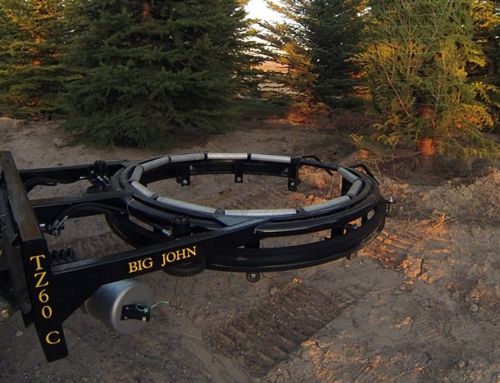
Tree Spades for the Southeast: A Buyer’s Guide for Florida, the Carolinas and Tennessee
Tree Spades for the Southeast: A Buyer’s Guide for Florida, the Carolinas and Tennessee
A field nursery in Middle Tennessee, a landscape contractor in the Carolina Piedmont and a crew digging Florida sand work different soils, on different digging calendars, under different road rules. This guide shows how those differences change the tree spade you buy, and which Big John model fits each job.
Big John Manufacturing has built tree spades in Heber Springs, Arkansas, since 1975 and sells them to nurseries, contractors and municipalities. It does not move trees for property owners. Big John figures below come from its model pages; state figures come from the public sources listed at the end.
Size by Root Ball First
The tree caliper to rootball calculator applies the ANSI Z60.1 rule of 10 to 12 inches of root ball per inch of caliper, measured 6 inches above ground on trunks up to 4 inches and 12 inches above on larger ones. A 4-inch tree needs a 40 to 48-inch ball.
How the Four States Differ
Big John’s month-by-month transplanting guide groups USDA hardiness zones into bands and rates each month, so your zone sets your digging calendar. Your soil sets your blade.
| State | 2023 USDA zones | Soils that drive blade choice |
|---|---|---|
| Florida | 8b to 11b | Sandy; Myakka fine sand is the state soil |
| North Carolina | 6a to 9a | Clay loams in the Piedmont and mountains, sandy loams on the coastal plain |
| South Carolina | 7b to 9b | Red clay in the Piedmont, sandier ground in the Sand Hills and on the coastal plain |
| Tennessee | 6a to 8a | Field nursery soils that hold a ball; shallow, rocky sites to avoid |
| State | Big John zone band | Months rated excellent |
|---|---|---|
| Florida | Warm, zones 8 to 10 (zone 11 is warmer than the table) | November to February |
| North Carolina | Temperate in the mountains, warm across most of the Piedmont and coastal plain | October, November and March in zones 6 to 7; November to February in zone 8 |
| South Carolina | Mostly warm; 7b only in the far Upstate | November to February |
| Tennessee | Mostly temperate; 8a around Memphis and Chattanooga | October, November and March |
Zones vary within a county, so check your ZIP code on the USDA map.
Florida
The 2023 USDA map runs Florida from zone 8b in parts of the Panhandle to 11b in the Keys. In zones 8 to 10, Big John’s table rates November through February excellent and says to avoid May through September. The South Florida coast and the Keys reach zone 11, warmer than any band in the table, so confirm timing there with your UF/IFAS county extension office. Big John’s guide to tree transplanting services adds a Southeast caution: large moves are generally avoided during Atlantic hurricane season, June through November, because a freshly moved tree is more vulnerable to wind.
Florida’s state soil, Myakka fine sand, covers about 1.4 million acres, mostly in the flatwoods of peninsular Florida, and formed in sandy marine deposits. Big John notes that sandy soil has almost no cohesion, so a ball without a clean, consistent cut can crumble in transport. Its 30-degree pointed blades work well in very sandy soils and narrow the bottom of the ball to cut soil loss.
A field nursery digging 1 to 5-inch stock in prepared rows fits the skid steer line. For larger trees moved out of unprepared sand, look at the truck line: each truck spade carries a water tank for unprepared digging, and Big John says the 90D’s dual contoured blades stand up to tough, rocky and sandy soils.
North Carolina
North Carolina runs from zone 6a in the western mountains to 9a at its warmest coastal points. The USDA map puts most of the Piedmont and coastal plain in zone 8, so most growers east of the mountains follow the warm calendar; the northern Piedmont edges into zone 7, so check your ZIP code. In zones 6 and 7, Big John rates October, November and March (before bud break) excellent and December through February good while dormant, with January depending on workable ground.
A 2025 NC State Extension survey of row crop fields found coastal plain topsoils were generally sandy loams and Piedmont and mountain topsoils clay loams, with average clay contents of 20 and 30 percent. For prepared nursery ground in Piedmont clay, Big John’s 22-degree truncated blades are designed for harder clay and cut a pot-shaped ball that is easy to basket and burlap. On sandier coastal plain ground, pointed blades fit. Clay also adds weight: the calculator says wet clay can run 20 to 30 percent heavier than its estimates.
For 6 to 7-inch trees moved between job sites on Piedmont clay, the 65D cuts a 62-inch ball, weighs 12,760 lbs and lists about 12 ft 2 in. tall for transport.
South Carolina
South Carolina runs from zone 7b in the far Upstate to 9b on parts of the coast, with most of the state in zone 8, so nearly every site follows Big John’s warm calendar: November through February excellent, October a good opening.
The SC Department of Natural Resources describes Piedmont soils, about 32 percent of the state, as deep, red and clayey, the Sand Hills as sandy to fine-loamy, and the coastal plain, about half the state, as sandy to clayey. Big John’s Model 20, 28, 36 and 44 pages list pointed, semi-truncated and truncated blades, and its guide to skid steer spade blade configurations explains each shape. Those skid steer models are nursery diggers built for prepared ground. A contractor digging unprepared site soil should look instead at the loader-mounted 42DL for 1 to 4-inch trees, which fits large skid steers, or at a truck spade for larger trees.
Tennessee
Tennessee runs from zone 6a in the eastern mountains to 8a around Memphis and Chattanooga, with most of the state in zone 7, Big John’s temperate band. UT Extension’s nursery field production handout gives the same season: nursery crops are planted and harvested while dormant, “Oct through March generally.” It says Middle Tennessee has “a soil that will ball,” describes a good nursery soil as a deep, well-drained silt loam with no rocks, and advises avoiding rock outcroppings and shallow soils.
On equipment, the handout suggests a new grower might buy a spade that digs 20 to 24-inch balls in the second or third year of production and one that digs 24 to 28-inch balls in the third or fourth, and names a skid steer or articulating loader as the preferred carrier. In Big John’s line, the closest sizes are the 20-inch Model 20 and the 28-inch Model 28; both list an adjustable root ball width, so ask the factory how far each one adjusts. Semi-truncated blades are made for nursery digging and easy transfer to flat-bottom baskets. Landscapers on unprepared or rocky sites need a different machine: the calculator notes that rocky or compacted soils may require a pointed blade, and the 42DL, built for unprepared soils and 1 to 4-inch trees, or a truck spade fits that work.
Matching Big John Models to the Job
All three lines are on the Big John tree spades page.
Nursery field digging: skid steer Models 20 to 54
Big John’s skid steer tree spade attachments are nursery diggers built for prepared ground. Every model lists a 10 to 16 GPM drive system, AR400 blades and a hydraulic gate lock.
| Model | Trunk caliper | Root ball width |
|---|---|---|
| Model 20 | 1 to 2 in. | 20 in. |
| Model 28 | 1 to 3 in. | 28 in. |
| Model 36 | 1 to 3 in. | 36 in. |
| Model 40 | 1 to 4 in. | 40 in. |
| Model 44 | 1 to 4 in. | 44 in. |
| Model 48 | 1 to 5 in. | 48 in. |
| Model 54 | 1 to 5 in. | 54 in. |
A model’s caliper range is not the ball size the 10 to 12-inch rule calls for. The Model 28 is rated to 3-inch trees, but a 3-inch tree wants a 30 to 36-inch ball, and Big John’s calculator points 3-inch trees to the Model 36 or Model 44. If your trees sit at the top of a model’s range, size up.
Spade weight runs from 1,200 lbs on the Model 20 to 3,000 lbs on the Model 54. Add the root ball weight from the model page and compare the total with your loader’s rated operating capacity. The skid steer tree spade buying guide covers flow and coupler checks.
Landscape contractors and tree movers: truck-mounted 45D to 100D
A truck-mounted tree spade digs, carries and plants on one rig.
| Model | Trunk caliper | Root ball width |
|---|---|---|
| 45D | 3 to 4 in. | 42 in. |
| 55D | 5 to 6 in. | 52 in. |
| 65D | 6 to 7 in. | 62 in. |
| 80D | Up to 10 in. | 80 in. |
| 90D | 10 to 12 in. | 90 in. |
| 100D | 12 to 14 in. | 100 in. |
Municipal crews and occasional use: trailer-mounted
Big John aims its trailer-mounted tree spades at landscapers and municipal applications and describes them as built for occasional use. The 55DTD handles 4 to 5-inch trees with a 52-inch ball and the 65DTD 6 to 7-inch trees with a 62-inch ball, both on a 236-inch trailer 96 inches wide.
Hauling a Truck Spade on Southeast Roads
Each truck model page lists the figures a truck builder and a permit office will ask about:
| Model | Spade weight + root ball weight (approx.) | Closed transport width x height (approx.) |
|---|---|---|
| 45D | 5,800 + 1,500 lbs | 8 ft x 11 ft 2 in. |
| 55D | 12,260 + 3,600 lbs | 8 ft 5.75 in. x 11 ft 10 in. |
| 65D | 12,760 + 4,300 lbs | 8 ft 5.75 in. x 12 ft 2 in. |
| 80D | 15,760 + 8,500 lbs | 8 ft 5.75 in. x 13 ft 6 in. |
| 90D | 16,760 + 11,800 lbs | 8 ft 5.75 in. x 13 ft 6 in. |
| 100D | 21,000 + 15,000 to 18,000 lbs | 8 ft 5.75 in. x 13 ft 6 in. |
Big John labels these “Height Closed” and “Width Closed,” both “for Transportation, approx.,” and does not say which truck they assume. Before you plan a route:
- Width, height, length, axle weights and gross weight all count, measured on the loaded rig: truck, spade, root ball and a canopy that can stand above or spread beyond the spade.
- Limits and permit rules differ by state and by road, so a rig that runs one route may need a permit on another.
- Your truck builder or upfitter confirms the finished dimensions and axle weights of a specific rig, and the state DOT’s oversize/overweight permit office confirms what that rig needs.
Permit offices: Florida DOT, North Carolina DOT, South Carolina DOT and Tennessee DOT.
Buying New, Buying Used and Getting Support
New. Big John does not publish list prices. Its sales and service page lists the North America sales team. When you contact Big John, have ready your largest caliper, your carrier and its auxiliary flow (for a truck spade, ask how the truck is handled), your soil and where you work.
Used. The used tree spades list carries trade-ins and demo units, including models that may no longer be in production, and stock changes as units sell. Recent listings have included a 65D on a 2015 KW truck, 90DLP truck spades and nursery diggers. Give the team the stock number, your calipers, your machine and where you are located, so they can answer on fit, condition and logistics.
Financing and parts. The sales page lists equipment financing with approvals often within 24 hours and funding within 48 hours; ask whether it applies to your unit. It also says parts are ready to ship the same day in most cases.
If you will move trees for clients, the guide to tree transplanting cost breaks down what drives the price of a move.
Tree Spades in the Southeast: Common Questions
Where can I buy a tree spade in Florida, the Carolinas or Tennessee?
Big John builds its tree spades in Heber Springs, Arkansas, and sells them to nurseries, contractors and municipalities. Its Sales and Service page lists the North America sales team; contact that team for pricing and fit, since Big John does not publish list prices. For used units, check the used equipment list and tell the team where you are located.
What size tree spade does a nursery in the Southeast need?
Start with the caliper you dig most and the 10 to 12-inch rule: a 2-inch tree needs a 20 to 24-inch ball, a 3-inch tree a 30 to 36-inch ball. Size by the ball, not only by a model’s caliper range: Big John’s calculator points 3-inch trees to the Model 36 or Model 44. UT Extension suggests new growers start with a spade that digs 20 to 24-inch balls.
When is tree digging season in Florida, the Carolinas and Tennessee?
Big John’s zone table rates November through February excellent in warm zones 8 to 10, which cover most of Florida, most of South Carolina and most of North Carolina east of the mountains. In temperate zones 6 and 7, which cover most of Tennessee and the North Carolina mountains, October, November and March before bud break rate excellent.
Which tree spade blade suits sandy soil or clay soil?
Big John’s 30-degree pointed blades are an all-purpose option that works well in very sandy soils and narrows the ball to reduce soil loss, which suits Florida sand and sandy coastal plain ground. Its 22-degree truncated blades are designed for prepared nursery ground and harder clay, like the Carolina Piedmont, and cut a pot-shaped ball for basket and burlap.
What should I check before hauling a truck spade on Southeast roads?
Check the loaded rig, not just the spade: width, height, length, axle weights and gross weight, with the root ball and the tree’s canopy on board. Big John lists approximate closed transport figures and spade and root ball weights on each truck model page. Limits and permits differ by state and by road, so confirm a specific rig with your truck builder and the state DOT’s oversize/overweight permit office.
Does Big John move trees or offer transplanting services?
No. Big John builds and sells tree spades and does not move trees on customer properties. If you need a tree moved, hire a nursery, landscape company or contractor that runs a spade sized for your tree. If you move trees for a living and want your own machine, contact Big John about a new or used spade.
Sources
- USDA Agricultural Research Service, 2023 Plant Hardiness Zone Map, state maps
- USDA NRCS, Myakka soil series description, and Soil Science Society of America, Florida State Soil
- NC State Extension, Overview of the Soil Fertility Status of Representative Row Crop Fields in North Carolina (AG-982, 2025)
- SC Department of Natural Resources, soils study material
- UT Extension, Field Production handout for nursery growers (revised 2009)