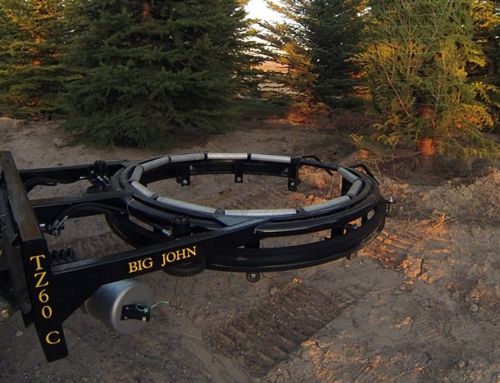
A 3-point hitch tree spade turns a tractor you already own into a tree moving machine. It mounts on the three-point linkage, cuts a root ball around the trunk, lifts the tree out intact and carries it to its new hole. Big John builds its tractor spades for prepared soil in nurseries and landscaping.
This guide covers how a tractor spade works, who it suits, how to match one to your tractor and how it compares with Big John’s other mounts. Big John does not publish a spec sheet for its 3-point models, so where a figure depends on your machine, the guide says what to check.
What Is a 3-Point Hitch Tree Spade?
A 3-point hitch is the linkage of two lower lift arms and a top link that a tractor raises and lowers hydraulically. A 3-point hitch tree spade is a tree spade on a frame built for that linkage, so the tractor carries it much like a mower or a box blade.
Big John says its tractor tree spades attach to the front or the back of most tractors and share the design features of its skid steer and loader-mounted spades. It describes them as heavy-duty machinery in a smaller package, good for spacing out trees and for working in tight spaces. The features it lists:
- Wireless or cabled remote controls, for running the spade from inside the tractor or, with the wireless remote, from anywhere.
- Stabilizing pads that widen the base during a dig, so you can apply more down pressure.
- Heavy-duty gate hinges designed for stressful conditions.
- Heavy-duty blade edges that cut through tough root systems with minimal annual maintenance.
- Durable slide blocks of top-grade plastics, which Big John says dig for thousands of tree moves with no bolts to rust.
Who It Fits
Big John aims its 3-point spade at nursery owners and landscapers who run a tractor, and also pitches it for farm tree transplanting. It fits best when you already own the tractor and dig mostly in prepared soil, the conditions Big John designs its tractor spades for.
For hard, unprepared ground, Big John makes its loader-mounted spades for tough digging conditions. To dig and haul on one machine between job sites, a truck-mounted spade carries the tree on the same rig. The table below compares the mounts.
How a Tractor Tree Spade Works
Big John explains the principle simply: the spade works with your tractor’s 3-point hitch system to dig around the root ball and lift it intact, which minimizes root damage. On most tree spades, the sequence runs like this:
- Dig the new hole first, often with the same spade, so the hole matches the root ball.
- Close in on the tree. Open the gate, bring the spade around the trunk and close the gate.
- Cut. Lower the spade onto its stabilizing pads and drive the blades into the soil from the remote.
- Lift and carry the tree with the hitch, slowly and with the load kept low.
- Plant. Set the ball in the hole, open the blades, lift the spade clear and water the tree in.
Blade layout shapes the root ball. Big John’s design traces back to John May’s patented spade with curved towers and four spoon-shaped blades, and Big John says its 3-point tractor-mounted spades come with pointed, truncated or semi-truncated blades. Its guide to tree spade blade configurations explains what each shape does.
Matching a Tree Spade to Your Tractor
Big John says its tractor spades attach to most tractors and are made to fit your needs, but it publishes no horsepower, hitch category or weight figures for them. The match is confirmed with the factory. Check these points in your tractor’s operator’s manual first.
Hitch Category
Rear 3-point hitches come in standardized categories. The international standard ISO 730 names eight, from Category 1N to Category 4, and sets the linkage dimensions for each. Your manual lists your tractor’s category. Implements do not always cross categories without changes, so include yours when you ask for a quote.
Lift Capacity and Balance
The hitch must raise the spade plus a root ball full of soil. Your manual gives the 3-point lift capacity; ask Big John what the spade weighs. For the ball, Big John’s calculator estimates about 750 pounds at 30 inches in loamy soil, and says wet clay can run 20 to 30 percent heavier.
Writing about round bales, Penn State Extension warns that lifting a load too high on a rear-mounted 3-point lift shifts the center of gravity back and may raise the front, and that front tires barely touching the ground can cause steering and stability problems.
A root ball loads the hitch the same way. Keep it low and add front counterweights as your manual directs.
Hydraulics and Power
A tree spade runs on hydraulics. Big John does not publish the flow or pressure its 3-point models need, or whether they run from the tractor’s remote outlets or a separate pump, such as a PTO-driven one. Ask, then compare the answer with the outlets and flow listed in your manual.
Front or Rear Mount
Big John says its tractor spades can go on the front or the back of most tractors. A rear mount uses the standard hitch. A front mount needs a front 3-point hitch, which many tractors lack, so confirm yours has one.
Have this ready when you call:
- Tractor make, model and year.
- Hitch category and rated lift capacity.
- Remote hydraulic outlets and their flow.
- The tree sizes you move most, and your soil type.
What Size Trees Does a Tractor Spade Suit?
Big John lists its tractor tree spades in models from 20 to 60 inches, and says any spade in that range can be fitted to a tractor with a specialized three-point hitch model. It publishes no caliper ratings for the 3-point versions, so confirm the tree size range for your tractor with the factory. Published sizes for the other mounts:
| Mount | Published tree size | Big John’s stated fit |
|---|---|---|
| Skid steer attachment (Model 20 to Model 54) | 1 to 5 inches | Prepared-ground nursery digging, lightweight |
| Trailer-mounted (44DTG, 54, 55DTD, 65DTD) | 1 to 7 inches | Landscapers and municipal crews; tow-along, for occasional use |
| Loader-mounted (42DL to 100DL) | 1 to 14 inches | Tough digging and sandy soil; application: loaders, tractors |
| Truck-mounted (45D to 100D) | 3 to 14 inches | Digging and transport on one rig |
| Tractor, 3-point hitch | Not published; ask the factory | Prepared soil, nurseries and landscaping |
Big John’s loader-mounted DL models also list tractors as a host machine, and their product pages publish full specs. Those pages do not say how a DL attaches to a tractor, so ask the factory which suits your tractor, or browse all Big John tree spades.
Size the Root Ball Before You Choose
Start from the trees, not the machine. Big John’s tree caliper to rootball calculator applies the ANSI Z60.1 rule of 10 to 12 inches of root ball diameter per inch of trunk caliper, and estimates the ball’s weight.
- Measure caliper 6 inches above the ground on trunks up to 4 inches, and 12 inches above on larger trunks.
- Size for the largest tree you move in a typical year.
- Add the root ball and spade weights, and compare the total with your lift capacity.
Getting Good Results
- Dig in workable soil. Big John designs its tractor spades for prepared soil, so very hard or rocky ground calls for a heavier machine or better timing.
- Inspect before each use: hoses, pins, blade edges and the hitch connection.
- Set the depth for the tree, and keep the ball intact as you lift and set it.
- Handle trees gently in transit.
Big John says anyone can learn to operate its spades with minimal instruction and dig a tree in a matter of minutes. Still, train every operator on your own tractor before the season.
Safety With a Tractor-Mounted Spade
A spade on a 3-point hitch adds a heavy, moving load to a tractor, so tractor safety and spade safety both apply. Big John’s tree spade safety guide covers OSHA rules, training and PPE. The tractor-specific points:
- Call 811 before you dig, so buried utility lines are marked.
- Keep the rollover protective structure (ROPS) in place and wear the seat belt.
- Keep people clear of the hitch, the blades and the spade’s swing path; a rear load swings wide in turns.
- Take slopes slowly, with the load low.
- Lower the spade to the ground before you leave the seat, and never work under a raised spade.
- Relieve hydraulic pressure before servicing, and check for leaks with cardboard, never your hand.
Maintenance for a 3-Point Hitch Spade
Big John calls maintenance on its spades simple, quick and affordable. The routine matches any spade: clean off soil after digging, grease the pivot points, check hoses and fittings, and service it fully at season’s end. On a tractor unit, also check the lift arm and top link pins, their keepers and the hydraulic couplers.
The full routine and a printable checklist are in Big John’s tree spade maintenance tips and winter checklist. The parts and service team says it has parts ready to ship the same day in most cases, and it answers routine and preventive maintenance questions.
Find the Right Spade for Your Tractor
Big John Manufacturing has built tree spades in Heber Springs, Arkansas, since 1975. Contact Big John with your tractor details and tree sizes to get a spade matched to your machine, and see the features every model shares on the tractor tree spade attachments page.
Related guides
- Skid steer tree spade buying guide: Carrier fit for Bobcat, CAT, Kubota and John Deere, hydraulic flow needs and spade sizing.
- Choosing tree moving attachments: Factors for picking tractor, skid steer and limb management attachments for tree relocation projects.
- Tree transplanting attachments: Skid steer, tractor, limb saw and tree spade attachments, and the features worth checking.
- Tips for tree moving attachments: Four tips and field techniques for moving trees with tractor attachments.
3-Point Hitch Tree Spade: Common Questions
Will a tree spade fit my tractor?
Big John says its tractor spades attach to the front or the back of most tractors with a 3-point hitch. Fit depends on your hitch category, lift capacity and hydraulics, so check those in your manual and confirm the match with the factory before you order.
What size tree can a 3-point hitch tree spade move?
Big John lists its tractor spades in models from 20 to 60 inches but publishes no caliper ratings for them. Size the root ball you need with the caliper calculator, then ask the factory which spade your tractor can carry.
Do I need a PTO to run a tractor tree spade?
Big John does not publish how its 3-point models are powered. A spade runs on hydraulics, so the question is where the oil comes from: the tractor’s remote outlets or a separate pump. Ask the factory what flow and pressure the spade needs.
Is a 3-point hitch, skid steer or trailer spade better?
It depends on what you own and where you dig. A 3-point spade suits tractor owners digging in prepared soil. Big John’s skid steer spades handle 1 to 5 inch trees in prepared nursery ground, and its trailer spades handle 1 to 7 inch trees and tow between job sites.
Can a tree spade mount on the front of a tractor?
Big John says its tractor spades can attach to the front or the back of most tractors. A front mount needs a front 3-point hitch, so confirm your tractor has one and that its front lift capacity covers the spade and the root ball.
How heavy is a tree root ball?
Heavier than most people expect. Big John’s calculator estimates a 30-inch root ball in loamy soil at about 750 pounds and a 60-inch ball at about 6,000 pounds, with wet clay running 20 to 30 percent heavier. Add the spade’s weight before comparing with your lift capacity.